College Writing Workshop: Professor Young
19 September 2017
Is Kneeling the Right Thing to Do
The date of August 26th, 2016 marks the day in which a movement would be started throughout the nation. This was the day in which Colin Kaepernick took a seat during the National anthem. When confronted about it later by an NFL.com reporter, he did not hesitate and stated, "I am not going to stand up to show pride in a flag for a country that oppresses black people and people of color." As stated in the article "The Perilous Fight" by Sean Gregory, the criticism came hard and fast. Many were outraged by this, one congressman saying he was, "sympathetic to ISIS" while an anonymous NFL executive stated he wanted Kaepernick no where near his team and that he was a "traitor."


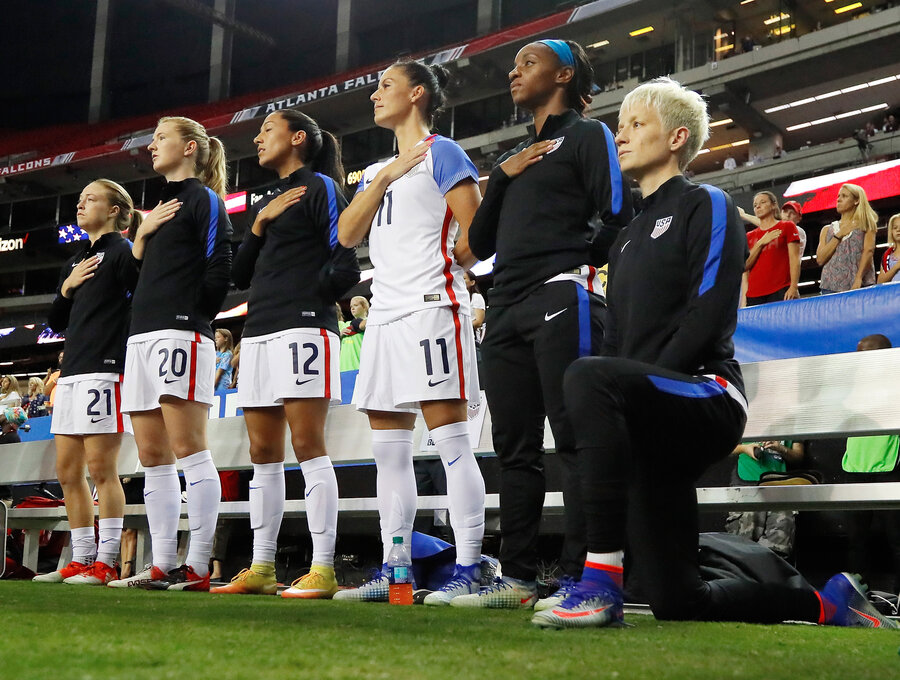
 But, with hate, there was also support. Athletes and teams across the nation were starting to take a stand, or rather, take a knee as well to support Colin Kaepernick and the cause. The likes of big name athletes followed his lead, such as Eric Reid, Jeremy Lane, Megan Rapinoe, and more recently Michael Bennett, along with many others. Some athletes even lost big endorsement deals because they kneeled during the national anthem. Brandon Marshall, a Denver Broncos linebacker, lost two endorsement deals because of his actions. Younger sports teams, such as colleges and high schools are starting to do this as well. Woodrow Wilson high school in Camden, pre teen football teams, Minneapolis South High School girls volleyball team, etc. The movement was astonishing, and all it took was one man to stand up and start it.
With all this commotion, the question arises, was this the right thing to do? In my opinion, it was not the right thing to do. The workplace and your political views should not mix, no matter how hard you may feel. It does not matter if you are a businessman working in a cubicle, or a professional football player making millions of dollars. There are plenty of other ways to get your view across, but not during a game. It is a family game, and is meant to be watched so people can relax and almost get away from the problems in the world at the time. When players bring political views into their respective sports, it simply makes it not as enjoyable with all of the added tension. A message sent out to players and athletes in the 70's should be used and followed today while in the work place, stating, "Say little and offend no one. Be grateful for the opportunities you have. Doing otherwise could cost a player dearly..."

Now this is not me saying you shouldn't stand up for what you believe in, as I am all for it. But, keep it off the field, court, etc. Some alternatives could be using twitter, running campaigns, protests, wearing clothing expressing your feelings, etc. There are countless other ways to do so. Also, this is disrespecting families of veterans and veterans themselves, because they aren't getting the respect they deserve for fighting for our country. Military protestors called the protestors unpatriotic, while police forces threatened to stop providing security at NFL games. Even a NFL Hall of Famer and a civil rights activist Jim Brown stated, "I would not challenge our flag. I would not do anything that has to do with respecting the flag or the national anthem. I don't think it's appropriate." Overall, I do not think this is a just way to deal with the problem, as there are plenty of other ways to deal with it outside of your sport, and disrespecting the national anthem is just not the right call.

Reply to the comment:
Can you elaborate on this point: "Say little and offend no one." How does this point connect and/or relate to Kaepernick?
This relates to Kaepernick in the sense that, when on the job, you should very simply put, do your job. There is no need to speak, or show, your political stance when working. Essentially, say little so you do not offend others while playing the game everyone loves to watch. This brings unwanted stress and tension to the game. Whatever Kaepernick says off the field is up to him. However, when he is on the field, he should keep it to himself.